


Quotes by
William Hazlitt |
1778-1830 , English essayist & critic
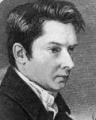 English writer best known for his humanistic essays. Lacking conscious artistry or literary pretention, his writing is noted for the brilliant intellect it reveals.
 | 105 quotes | 3,821 visits |
Quotations
| • | Political truth is libel; religious truth, blasphemy. 9 |
| • | The art of life is to know how to enjoy a little and to endure much. 7 |
| • | A knave thinks himself a fool, all the time he is not making a fool of some other person. 6 |
| • | A woman’s vanity is interested in making the object of her choice the god of her idolatry. 6 |
| • | If we use no ceremony towards others, we shall be treated without any. People are soon tired of paying trifling attentions to those who receive them with coldness, and return them with neglect. 6 |
| • | The more we do, the more we can do; the more busy we are, the more leisure we have. 6 |
| • | Some persons make promises for the pleasure of breaking them. 6 |
| • | If we wish to know the force of human genius, we should read Shakespeare. If we wish to see the insignificance of human learning, we may study his commentators. 5 |
| • | People do not seem to talk for the sake of expressing their opinions, but to maintain an opinion for the sake of talking. 4 |
| • | Of all eloquence a nickname is the most concise; of all arguments the most unanswerable. 4 |
| • | Prosperity is a great teacher; adversity is a greater. Possession pampers the mind; privation trains and strengthens it. 4 |
| • | When a thing ceases to be a subject of controversy, it ceases to be a subject of interest. 4 |
| • | Vice is man’s nature: virtue is a habit –or a mask. 2 |
| • | If mankind had wished for what is right, they might have had it long ago. 2 |
| • | A gentle word, a kind look, a good-natured smile can work wonders and accomplish miracles. 2 |
| • | He will never have true friends who is afraid of making enemies. 2 |
| • | The only vice which cannot be forgiven is hypocrisy. The repentance of a hypocrite is itself hypocrisy. 2 |
| • | It is well that there is no one without a fault; for he would not have a friend in the world. 2 |
| • | The seat of knowledge is in the head; of wisdom, in the heart. We are sure to judge wrong, if we do not feel right. 1 |
| • | We do not see nature with our eyes, but with our understandings and our hearts. 1 |
| • | The mind of man is like a clock that is always running down, and requires to be constantly wound up. 1 |
| • | We are not satisfied to be right, unless we can prove others to be quite wrong. 1 |
| • | The best way to make ourselves agreeable to others is by seeming to think them so. If we appear fully sensible of their good qualities they will not complain of the want of them in us. 1 |
| • | We often choose a friend as we do a mistress –for no particular excellence in themselves, but merely from some circumstance that flatters our self-love. 1 |
| • | Walk groundly, talk profoundly, drink roundly, sleep soundly. 1 |
| • | The great requisite for the prosperous management of ordinary business is the want of imagination. 1 |
| • | A great chessplayer is not a great man, for he leaves the world as he found it. 1 |
| • | The imagination is of so delicate a texture that even words wound it. 1 |
| • | The most silent people are generally those who think most highly of themselves. 1 |
| • | Lying is the strongest acknowledgment of the force of truth. 1 |
| • | Despair swallows up cowardice. 1 |
| • | Defoe says that there were a hundred thousand country fellows in his time ready to fight to the death against popery, without knowing whether popery was a man or a horse. 1 |
| • | True friendship is self-love at second-hand. 1 |
| • | People are not soured by misfortune, but by the reception they meet with in it. 1 |
| • | Fashion is gentility running away from vulgarity and afraid of being overtaken. 1 |
| • | The characteristic of Chaucer is intensity: of Spencer, remoteness: of Milton elevation and of Shakespeare everything. 1 |
| • | Those who can command themselves command others. 1 |
| • | Who likes not his business, his business likes not him. 1 |
| • | It is not fit that every man should travel; it makes a wise man better, and a fool worse. 1 |
| • | A hair in the head is worth two in the brush. 1 |
| • | The best kind of conversation is that which may be called thinking aloud. 1 |
| • | The worst old age is that of the mind. 1 |
| • | Time —the most independent of all things. 1 |
| • | A really great man has always an idea of something greater than himself. 1 |
| • | The person whose doors I enter with most pleasure, and quit with most regret, never did me the smallest favor. 1 |
| • | If you think you can win, you can win. Faith is necessary to victory. 1 |
| • | We never do anything well till we cease to think about the manner of doing it. This is the reason why it is so difficult for any but natives to speak a language correctly or idiomatically. 1 |
| • | Those people who are always improving never become great. Greatness is an eminence, the ascent to which is steep and lofty, and which a man must seize on at once by natural boldness and vigor, and not by patient, wary steps. 1 |
| • | The measure of any man’s virtue is what he would do, if he had neither the laws nor public opinion, nor even his own prejudices, to control him. 1 |
| • | The way to procure insults is to submit to them. A man meets with no more respect than he exacts. 1 |
| • | The devil was a great loss in the preternatural world. He was always something to fear and to hate; he supplied the antagonist powers of the imagination, and the arch of true religion hardly stands firm without him. 1 |
| • | We are never so much disposed to quarrel with others as when we are dissatisfied with ourselves. 1 |
| • | Violent antipathies are always suspicious, and betray a secret affinity. 1 |
| • | Life is a continued struggle to be what we are not, and to do what we cannot. 1 |
| • | The art of conversation is the art of hearing as well as of being heard. 1 |
| • | A nickname is the hardest stone that the devil can throw at a man. 1 |
| • | Zeal will do more than knowledge. 1 |
| • | Honesty is one part of eloquence. We persuade others by being in earnest ourselves. 1 |
| • | Rules and models destroy genius and art. 1 |
| • | Our repugnance to death increases in proportion to our consciousness of having lived in vain. 1 |
| • | Popularity is neither fame nor greatness. 1 |
| • | Common sense, to most people, is nothing more than their own opinions. 1 |
| • | Actors are the only honest hypocrites. 1 |
| • | No really great man ever thought himself so. 1 |
| • | Books let us into their souls and lay open to us the secrets of our own. 1 |
| • | Nothing is more unjust or capricious than public opinion. 1 |
| • | Landscape painting is the obvious resource of misanthropy. 1 |
| • | To be capable of steady friendship or lasting love, are the two greatest proofs, not only of goodness of heart, but of strength of mind. 1 |
| • | Those who are at war with others are not at peace with themselves. 1 |
| • | To get others to come into our ways of thinking, we must go over to theirs; and it is necessary to follow, in order to lead. 1 |
| • | The player envies only the player, the poet envies only the poet. 1 |
| • | Men of genius do not excel in any profession because they labour in it, but they labour in it because they excel. 1 |
| • | An honest man speaks the truth, though it may give offense; a vain man, in order that it may. 1 |
| • | The true barbarian is he who thinks every thing barbarous but his own tastes and prejudices. 1 |
| • | The most learned are often the most narrow-minded men. 1 |
| • | Every man, in his own opinion, forms an exception to the ordinary rules of morality. 1 |
| • | The truly proud man knows neither superiors nor inferiors. The first he does not admit of: the last he does not concern himself about. 1 |
| • | Cunning is the art of concealing our own defects, and discovering other people's weaknesses. 1 |
| • | The public have neither shame or gratitude. 1 |
| • | Hope is the best possession. None are completely wretched but those who are without hope; and few are reduced so low as that. 1 |
| • | Though familiarity may not breed contempt, it takes off the edge of admiration. 1 |
| • | No young man believes he shall ever die. 1 |
| • | I should on this account like well enough to spend the whole of my life in traveling abroad, if I could anywhere borrow another life to spend afterwards at home. 1 |
| • | No man is truly great who is great only in his lifetime. The test of greatness is the page of history. 1 |
| • | Modesty is the lowest of the virtues, and is a real confession of the deficiency it indicates. He who undervalues himself is justly undervalued by others. 1 |
| • | Great thoughts reduced to practice become great acts. 1 |
| • | Indolence is a delightful but distressing state; we must be doing something to be happy. 1 |
| • | Wit is, in fact, the eloquence of indifference. 1 |
| • | Wit is the salt of conversation, not the food. 1 |
| • | Man is the only animal that laughs and weeps; for he is the only animal that is struck with the difference between what things are, and what they ought to be. 1 |
| • | The love of liberty is the love of others; the love of power is the love of ourselves. 1 |
| • | We are all of us more or less the slaves of opinion. 1 |
| • | Those who make their dress a principal part of themselves, will, in general, become of no more value than their dress. 1 |
| • | Poetry is the universal language which the heart holds with nature and itself. He who has a contempt for poetry, cannot have much respect for himself, or for anything else. 1 |
| • | All that is worth remembering in life, is the poetry of it. 1 |
| • | Grace is the absence of every thing that indicates pain or difficulty, or hesitation or incongruity. 1 |
| • | Grace in women has more effect than beauty. 1 |
| • | Grace has been defined the outward expression of the inward harmony of the soul. 1 |
| • | The origin of all science is in the desire to know causes; and the origin of all false science and imposture is in the desire to accept false causes rather than none; or, which is the same thing, in the unwillingness to acknowledge our own ignorance. 1 |
| • | Man is a make-believe animal — he is never so truly himself as when he is acting a part. 1 |
| • | I hate to be near the sea, and to hear it roaring and raging like a wild beast in its den. It puts me in mind of the everlasting efforts of the human mind, struggling to be free, and ending just where it began. 1 |
| • | You know more of a road by having traveled it than by all the conjectures and descriptions in the world. 1 |
| • | Look up, laugh loud, talk big, keep the colour in your cheek and the fire in your eye, adorn your person, maintain your health, your beauty, and your animal spirits, and you will pass for a fine man. 1 |
| • | Those who aim at faultless regularity will only produce mediocrity, and no one ever approaches perfection except by stealth, and unknown to themselves. 1 |
| • | I’m not smart. I try to observe. Millions saw the apple fall but Newton was the one who asked why. 1 |