Quotes by
Eric Hoffer |
1902-1983 , American writer & philosopher
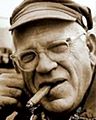 American longshoreman and philosopher whose writings on life, power, and social order brought him fame.
He was self-educated (claimed to have had no formal schooling). This and his working-class background made Hoffer into a sort of popular hero.
He was the author of ten books. The True Believer (1951), was widely recognized as a classic, but Hoffer believed that The Ordeal of Change (1963) was his best work.
| 40 quotes | 4,528 visits |
Quotations
| • | Power corrupts the few, while weakness corrupts the many. 20 |
| • | You can discover what your enemy fears most by observing the means he uses to frighten you. 14 |
| • | Propaganda does not deceive people; it merely helps them to deceive themselves. 12 |
| • | People who bite the hand that feeds them usually lick the boot that kicks them. 12 |
| • | It is not actual suffering but a taste of better things which excites people to revolt. 9 |
| • | Our greatest pretenses are built up not to hide the evil and the ugly in us, but our emptiness. The hardest thing to hide is something that is not there. 8 |
| • | The end comes when we no longer talk with ourselves. It is the end of genuine thinking and the beginning of the final loneliness. 8 |
| • | Passionate hatred can give meaning and purpose to an empty life. 8 |
| • | A great man's greatest good luck is to die at the right time. 8 |
| • | A preoccupation with the future not only prevents us from seeing the present as it is but often prompts us to rearrange the past. 8 |
| • | When people are free to do as they please, they usually imitate each other. 8 |
| • | The less satisfaction we derive from being ourselves, the greater is our desire to be like others. 6 |
| • | The technique of a mass movement aims to infect people with a malady and then offer the movement as a cure. 6 |
| • | Lack of sensitivity is perhaps basically an unawareness of ourselves. 6 |
| • | Absolute faith corrupts as absolutely as absolute power. 6 |
| • | The basic test of freedom is perhaps less in what we are free to do than in what we are free not to do. 6 |
| • | Love-making is radical, while marriage is conservative. 5 |
| • | The opposite of the religious fanatic is not the fanatical atheist but the gentle cynic who cares not whether there is a god or not. 5 |
| • | An empty head is not really empty; it is stuffed with rubbish. Hence the difficulty of forcing anything in to an empty head. 5 |
| • | In every passionate pursuit, the pursuit counts more than the object pursued. 5 |
| • | In a time of drastic change it is the learners who inherit the future. The learned usually find themselves equipped to live in a world that no longer exists. 5 |
| • | Compassion is the antitoxin of the soul: where there is compassion even the most poisonous impulses remain relatively harmless. 5 |
| • | Disappointment is a sort of bankruptcy - the bankruptcy of a soul that expends too much in hope and expectation. 5 |
| • | Charlatanism of some degree is indispensable to effective leadership. 5 |
| • | Nationalist pride, like other variants of pride, can be a substitute for self-respect. 5 |
| • | A man by himself is in bad company. 4 |
| • | How much easier is self-sacrifice than self-realization. 4 |
| • | We run fastest and farthest when we run from ourselves. 4 |
| • | We cannot hate those who we despise. 4 |
| • | Our frustration is greater when we have much and want more than when we have nothing and want some. We are less dissatisfied when we lack many things than when we seem to lack but one thing. 4 |
| • | The uncompromising attitude is more indicative of an inner uncertainty than of deep conviction. The implacable stand is directed more against the doubt within than the assailant without. 4 |
| • | Every extreme attitude is a flight from the self. 4 |
| • | A dissenting minority feels free only when it can impose its will on the majority: what it abominates most is the dissent of the majority. 4 |
| • | Action is at bottom a swinging and flailing of the arms to regain one's balance and keep afloat. 3 |
| • | A heresy can spring only from a system that is in full vigor. 3 |
| • | Self-righteousness is a loud din raised to drown the voice of guilt within us. 3 |
| • | The ability to get along without an exceptional leader is the mark of social vigor. 3 |
| • | It is not at all simple to understand the simple. 3 |
| • | We are told that talent creates its own opportunities. But it sometimes seems that intense desire creates not only its own opportunities, but its own talents. 3 |
| • | It is the around-the-corner brand of hope that prompts people to action, while the distant hope acts as an opiate. 3 |