Quotes by
Hippocrates |
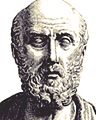
| 29 quotes | 7,747 visits |
Quotations
| • | It is far more important to know what person the disease has than what disease the person has. 16 |
| • | Let food be thy medicine and medicine be thy food. 11 |
| • | To do nothing is sometimes a good remedy. 9 |
| • | If you are in a bad mood, go for a walk. If you are still in a bad mood, go for another walk. 7 |
| • | To eat when you are sick, is to feed your sickness. 7 |
| • | When in a state of hunger, one ought not to undertake labor. 6 |
| • | Cure sometimes, treat often and comfort always. 5 |
| • | The soul is the same in all living creatures, although the body of each is different. 5 |
| • | Walking is man’s best medicine. 5 |
| • | In acute diseases it is not quite safe to prognosticate either death or recovery. 4 |
| • | The chief virtue that language can have is clearness, and nothing detracts from it so much as the use of unfamiliar words. 4 |
| • | The strongest things most especially and decidedly hurt man, whether in health or in disease. 3 |
| • | In whatever disease sleep is laborious, it is a deadly symptom; but if sleep does good, it is not deadly. 3 |
| • | When sleep puts an end to delirium, it is a good symptom. 3 |
| • | Timidity betrays want of powers, and audacity a want of skill. 3 |
Latin Quotes
| • | Art is long, life is short. Ars longa, vita brevis. 88 |
| • | First, do no harm. Primum, non nocere. (the origin is uncertain; Hippocrates’ works do not include this precise phrase) 87 |
Ancient Greek
| • | Life is short and Art long; the opportunity fleeting, experience deceitful, and judgment difficult. Ο βίος βραχύς, η δε τέχνη μακρή, ο δε καιρός οξύς, η δε πείρα σφαλερή, η δε κρίσις χαλεπή. (the first phrase in the “Aphorisms”) 47 |
| • | It is not possible to know medicine without knowing what a human is. Ουκ ένι ιατρικήν είδέναι, όστις μη οίδεν ό τι εστίν άνθρωπος. 43 |
| • | Time is that wherein there is opportunity, and opportunity is that wherein there is no great time Χρόνος εστίν εν ώ καιρός, και καιρός εν ώ χρόνος ου πολύς. 14 |
| • | The opposites are the cures of the opposites. Τα ενάντια τοις εναντίοις εισίν ιάματα. 8 |
| • | That which is used, gets stronger. That which is not used wastes away. Ότι χρήσις κρατύνει, αργίη δε τήκει. 7 |
| • | As to diseases, make a habit of two things, to help, or at least, to do no harm. Ασκείν περί τα νοσήματα δύο, ωφελείν ή μη βλάπτειν. 7 |
| • | Everything in excess is opposed to nature. Παν το πολύ τη φύσει πολέμιον. 7 |
| • | Those diseases which medicines do not cure, iron cures; those which iron cannot cure, fire cures; and those which fire cannot cure, are to be reckoned wholly incurable. Οκόσα φάρμακα ουκ ιήται, σίδηρος ιήται, όσα σίδηρος ουκ ιήται, πυρ ιήται όσα δε πυρ ουκ ιήται, ταύτα χρη νομίζειν ανίατα. (iron=knife, fire=searing iron) 5 |
| • | Extreme remedies are the best for extreme diseases. Ες δε τα έσχατα νουσήματα αι έσχαται θεραπείαι ες ακριβείην, κράτισται. 4 |
| • | Both sleep and sleeplessness, when immoderate, are bad. Ύπνος, αγρυπνίη, αμφότερα μάλλον του μετρίου γινόμενα, νούσος. 4 |
| • | People, to make a living, devise many and varied things. Άνθρωποι βίου δεόμενοι, πολλά και παντοία τεχνέονται. 1 |
| • | It is not possible to know medicine without knowing what a human is. Ουκ ένι ιατρικήν είδέναι, όστις μη οίδεν ό τι εστίν άνθρωπος. 1 |